Total Pageviews


Welcome to Riverswind notes

I hope you will join in my adventures here in Humboldt County and elsewhere as I explore nature & people.


I welcome your comments.


All Photos are protected by copyright and cannot be used without permission.


Wednesday, March 2, 2011

Watching Snowy Plovers

Western Snowy Plover and Sanderling

On some days while walking along Clam Beach and Little River State Beach I am fortunate to see the tiny Snowy Plover crouched low and motionless among the beach debris or in a shallow depression such as a human footprint in the sand.


When I walk past them they will often move away slowly walking as though they are stiff from sitting like an old man who has been glued to his chair for hours. During the winter months they can often be seen in loose flocks.


I watched 25 Snowy Plovers recently fly before me in synchrony flashing their wing markings along the surfs edge first south then turning abruptly in unison and flying back the other way.

They all landed abruptly like leaves dropping from a tree and instantly became invisible to the untrained eye.
The above is a photo just after landing showing how well they blend in with their background appearing as beach debris.
The majority of the individuals that I see have been banded by local biologists Mark Colwell, Matt Johnson and their students at Humboldt State University who are studying them to learn more about their biology, behavior, and movements.

The Pacific Coast population of the Western Snowy Plover has been listed as threatened since 1993 by the Federal Government due to declining numbers and decreased habitat as a result of introduced invasive vegetation such as European Beach grass. The Plover lays its eggs in depressions in the sand or river rock in open areas along the coast from Washington to Northern Baja, Mexico.

The threats to this “cute” sparrow sized plover are many and include natural predators like falcons, raccoons, coyotes, owls, fox, crows and ravens. The later has been determined to be the cause of most nest failures due to predation of the eggs when the parent has been disturbed.

However one of the major threats to the plover is human disturbance including Horses, bikes, vehicles, kite flying, and dogs running loose in the plovers nesting habitat.

Each time the tiny plover takes flight when disturbed they use valuable energy and often abandon their nest site making the eggs more vulnerable by increasing the opportunity for nest failure due to predation.

Much effort in cooperation with USFW and other Government agencies has been given to protect and improve the plover’s habitat.


The California Conservation Corps has been working on invasive
 European Beach grass removal west of the highway 101 Vista Point overlook by digging the grass up and burning it.


The above photo looking north toward the mouth of the Little River shows the roped off area that has been restored by mechanical removal of the European Beach Grass and then restoration with native plants.
.

This work allows native plants to compete and provides a more open
foredune habitat for the Snowy Plover.
The signs at the perimeter of the roped off area at Little River State Beach
do not keep unleashed dogs from running into their habitat.

Recently my wife and I were out photographing and observing Snowy Plovers.
We observed a middle aged woman and her unleashed dog walking along the roped off area.  The dog took off into the Snowy Plover protected habitat and I waved to the lady to indicate that her dog should not be there.

Her pace quickened as she approached me and she shouted "you better have a badge!"   Then before I could explain why we were concerned  she blurted out "I'm tired of this shit, and I'm calling 911." As she walked past us we heard her say pointing to the restoration area, "look what they've done already!"

She phoned someone while we watched her looking back at us as if we had ruined her day.

This is the challenge those of us concerned about protecting this tiny plover have when trying to educate people who simply don't care or refuse to listen to the facts.  I personally feel that most people are willing to listen and learn and hopefully change.

There are volunteers who often hand out educational material but I doubt that it changes those who just don't care.
Anyone reading who would like to volunteer go here.http://www.westernsnowyplover.org/volunteering.html
I would like to hear your ideas on how best we can protect this beautiful tiny plover whose numbers are declining.  Should people who ignore signs and allow their unleashed dogs to run through Snowy Plover habitat be ticketed? 

Sunday, December 19, 2010

Looking for Dead Birds


Photo by Kimberley Pittman-Schulz

My wife and I greatly enjoy our proximity to the Pacific Coast and walking along the many beaches here in Humboldt County.
We are volunteers with COASST as citizen scientist looking for dead beached birds that have washed ashore.
We've been involved with the program for a little over one year now and both of us look forward each month to our purposeful walk on "our" beach.


The way I found out about the program is interesting indeed.
I was checking out the mouth of the Mad River in early Febuary of 2009 and found a bottle with a lid and picked it up to see if there was a note in it.

There wasn't so I decided to put one in it and threw it into the river nearly 400 meters from the mouth. Perhaps I thought someone far away in some exotic place would eventually find it.

Gary Lester a local highly regarded birder and COASST volunteer found the bottle with the note and notified me by email the very next day.

Shortly after that I met Gary and his wife in person and he told me of the COASST volunteer program.
I took the COASST training class held in Trinidad, Ca and was assigned Clam Beach south.

It includes the area from the southern parking lot of Clam Beach County Park south to the Vista Point overlook approximately 1.7 Kilometers one way. It is a very flat and wide beach with the mouth of Strawberry Creek intersecting it about a third of the way.


Turkey Vultures and Ravens scavenging a dead Marine Mammal on Clam beach.

We sometimes find dead Marine mammals that have washed ashore including this scavenged Dolphin.


The purpose of the project is to monitor the marine ecosystems health in the Pacific Northwest. It is a cooperative effort by hundreds of volunteers from the Aleutians south to Humboldt County, California.


Assigned beaches are surveyed each month and data is collected on special data sheets. The data is analysed by scientist at the University of Washington and assembled into an annual report.


Data from all of the beaches surveyed reveal patterns which may help biologist make future decisions on the conservation of species of concern.


We enjoy the project for several reasons which include doing something outdoors together as a team and contributing in a small way to our knowledge about the Marine ecosystem.


Semipalmated Plover (Charadrius semipalmatus)


During our surveys we also enjoy getting close veiws of live birds that frequent our coastal beaches.

Western Sandpiper(Calidris mauri)

I must admit that it isn't always fun when you're hunched over a badly decayed specimen that falls apart at the slightest tug while trying to measure and Identify it in a cold wind.

The majority of birds found have been scavenged to some extent by other birds.


When we find one it is measured (tarsus,wing chord, bill) and identified when possible with the use of a key. We then mark it with color coded plastic cable ties and photograph it. Marking a bird prevents recounting it if it is found again by us or someone else. Thus far we have not stumbled upon anything rare or unusual like an Albatross or a Flesh footed Shearwater.

We have not experienced a "Wreck"* yet either and when and if we do we will be sure to call out the troops for help.

Most days we try to pick up as much litter that we find washed ashore.
Below is an example of a days find that we carried back to the dumpsters.

If I were younger and looking for a job it would be interesting to put this experience on my Resume and wait for a curious response by the potential employer during a interveiw.

*A wreck is a large number of single species, or group of species washed ashore sometimes resulting in 10 to 100 times normal.

Tuesday, October 26, 2010

Trash along roads


Every time I see trash deposited along our beautiful roads it makes me sad even sick to my stomach. Why I ask would a human with a brain do something so stupid?
Perhaps they are brainless but I'd rather think that they are people who have no respect for the environment or concern for their community.
Yesterday while driving home along Murray road I saw this and stopped to photograph it.

I am thinking about putting up some camera traps along this road to catch the idiots who disgrace the human race by their behavior.
>

I hope to catch someone eventually and turn them in. When caught they should be required to clean up the trash along the same roadway for at least one year or go to jail for a year.

This must cost taxpayer money that could be used for better purposes.

The trash was gone today apparently picked up by a local agency? Thank you to whoever cleaned up the outrageous mess.

Anyone out there with any suggestions that might help?

Tuesday, September 28, 2010

Sussi & Chuma Lodge on the Zambezi River

The last part of our Africa trip to Zambia was booked specifically to see Victoria Falls and wildlife along the Zambezi river.

Upon arrival at the airport near the northern border of Botswana we were met by a polite African gentelman and driven by cab to the rivers edge. Along the way we passed hundreds of large transport trucks waiting in line to cross the border.

Our driver explained that sometimes the wait was several days or over a week. This is because there are only two ferries and they can take only one semi trailer at a time.

We were told there is huge problem of prostitution with the truckers while they wait to cross the border.

Our connections were impeccable as we were met within 5 minutes by the person who would take us to the other side and crossed the river into Zambia by small motor craft.
The walk from the boat was over uneven terrain requiring at least a moderate amount of agility to get to the mobile office where our passports were checked taking only a few minutes and then proceeded to ride in a Van to our lodge.

We would stay two more nights at Sussi & chuma lodge on the banks of the Zambezi River.

We were greeted once again by very friendly and smiling hosts who led us along a platform walkway built on stilts to our room overlooking the river.
The entire lodge except the dining area was built on stilts to prevent flooding and to minimize the impact on the environment below.


Our room was at the end of the walkway and once inside it looked like this.
The view from our room was amazing and for the next two days we would soak up every moment. Looking out from our deck was a powerful humid ambiance showcasing the beauty of the Zambezi and it's richly diverse riparian sounds. We listened with reverence while the birds, insects and Hippos serenaded us to the tune of a swollen river as we soaked in this once in a lifetime experience .

It didn't take long for us to grab our binoculars and walk out on our deck to view the area and look for birds. There were many and one fine example was this beautiful little Bee-eater.
White-Fronted Bee-Eater (Merops bullockoides)
My faithful companion and fellow adventurer always with binoculars ready for anything that moves, crawls or flies.

She found a frog in our bathroom and we eventually released it to the outside and photographed it on the deck railing. Perhaps someone who knows African amphibians can identify it for us?
The first afternoon we chose to take a boat ride on the Zambezi where we encountered a family of Hippos that greeted us with disdain for our intrusion upon their space.
The Hippopotamus is one of the most dangerous animals in Africa and very territorial when in the water. They put up a very impressive argument that convinced everyone that we were close enough.

Brown-Hooded Kingfisher (Halcyon albiventris)

The bird life along the river was phenomenal and one example is this beautiful little Kingfisher(above).
That evening we enjoyed the relaxing atmosphere at the Main lodge with a glass of wine and excellent food and a superb view of the Zambezi river. The Staff entertained us with music and dancing and invited us to join them. We did and below is Kimberley feeling the African groove.
The next morning we were visited by a family of Vervet Monkeys near our room and immediately went out to observe, enjoy and photograph them.


These monkeys are undoubtedly curious by nature and very unafraid as they approached us closely.

As we gazed into each other's eyes I wondered what is going on in her mind? I think she wanted to be friends and at that moment we became friends.

The male Vervet monkey showing off his colorful genitalia while a female grooms his fur.
I thought to myself now why didn't Homo sapiens evolve such a colorful scheme?
Although the adaptive significance of the colored genitalia may not be well understood, it is thought to aid in visual communication among male Vervets to reinforce the dominance hierarchy.


The Bateleur (terathopius ecaudatus) is one of the most striking and easily identified eagles in Africa. We saw these beautiful eagles at every place we visited while in Africa.

This large Rock Monitor moved quickly away from us as we approached it.

The Red-Billed Oxpeckers (Buphagus erythrorhynchus) were busy keeping ectoparasites at bay on the backs of these Impala (Aepyceros melampus).
White-Crowned Lapwing (Plover) (Vanellus albiceps)

Driving along bumpy roads in a Land Rover not far from our lodge we were consumed with the many birds and mammals and keeping our eyes wide open hoping to see the Pel's Fishing Owl. It was perfect habitat but this is one bird that I would only get a fleeting glimpse of in the Okavanga.

On our last day in Africa we visited Victoria Falls and felt its awesome power and the deafening sound as we walked in its drenching rain along the trails .
A beautiful rainbow created by the falls mist .

High water at one of the "Seven Wonders" of the world. We waited a long time for this adventure and it will remain one of the highlights of our lives.


Tuesday, June 15, 2010

Chobe Nat. Park, Savute

Our flight to our next lodge in the Chobe National Park was a little over an hour. We were met at the airport and driven about 30 minutes to the Savute Safari Lodge where we would spend the next two days. Our room looked out over a water hole that had Elephants drinking from it and the odor of elephant dung wafted in the air.

The Chobe is known for having one of the worlds largest elephant populations and is
the second largest national park in Botswana encompassing nearly 11,000 sq. km. renowned for its uniqueness and abundance of wildlife.

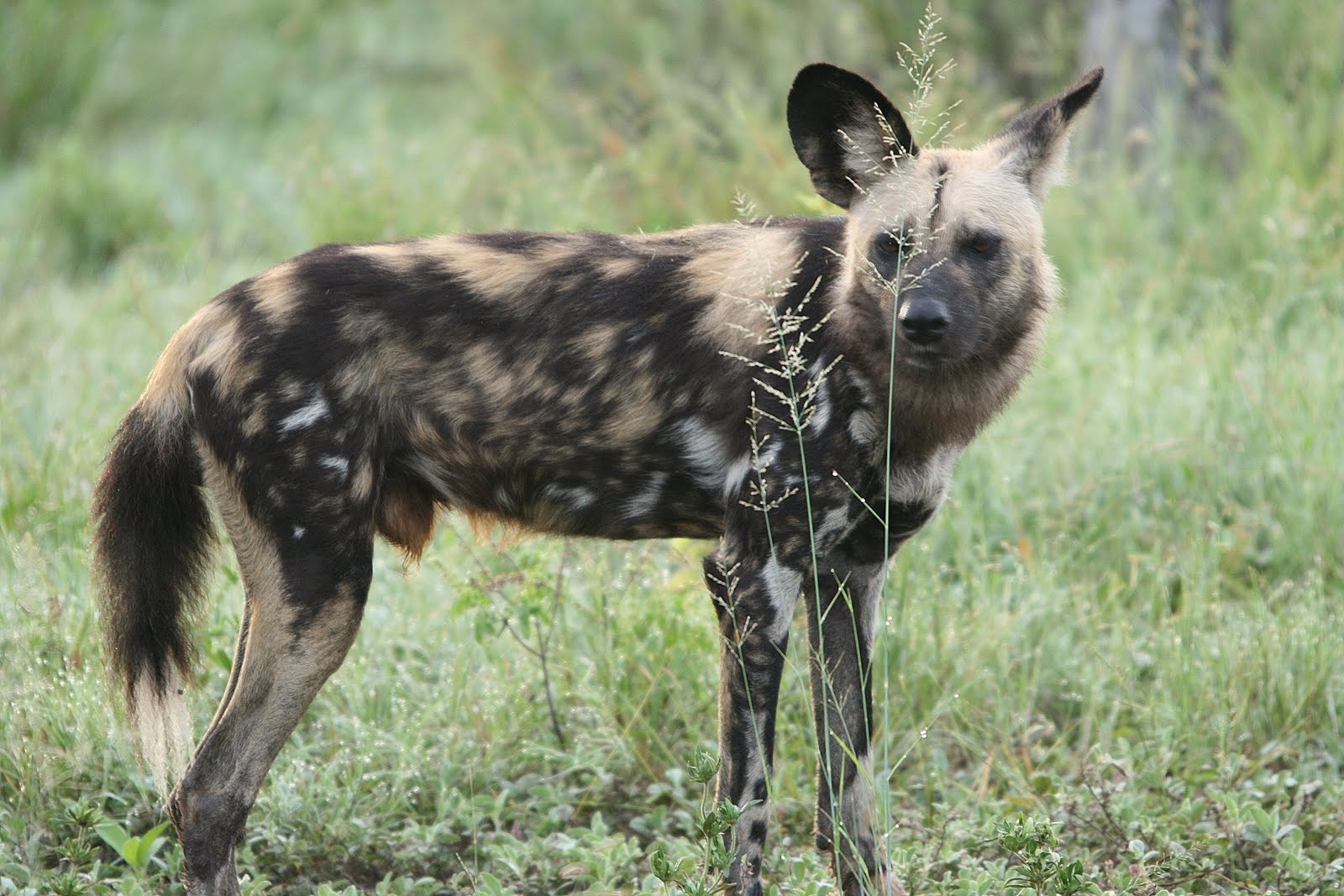
The African Wild Dog has large rounded ears a "Hyena-like" head and beautiful
mottled black, white with shades of light yellow brown patches of short hair giving it a
very distinctive appearance.
This beautiful dog-like animal is only a distant relative to our domestic canids.
A small pack of four adults were found napping under a tree in the late afternoon.
We waited patiently until they arose to begin their evening sojourn and watched them eagerly as they trotted slowly away.

They are exclusively carnivorous and like the North American Wolf, hunt for their prey cooperatively. They can run up to 35 mph and as long as 3 miles making it difficult for their prey to escape.
We were thrilled to experience the sight of these rare animals since they are considered endangered with only 5,000 of them remaining.

The Blackbacked Jackal reminded us of the North American Coyote by the way it moves.
It has a distinctive black and silver "saddle."
An interesting habit of laying on Elephant dung to mask its odor also hides it from predators.

Our guide was a big African gentleman named Ngande with a deep voice and keen sense of humor. I found out early that he was not into birds as much as we were but he quickly caught on when I was stopping him frequently to take photos.

A common resident throughout Botswana is the beautiful Lilac Breasted Roller.

The Kori Bustard (Ardeotis kori) is the largest bustard in Botswana and have become extinct in some areas due to habitat destruction from agriculture, development, hunting and a slow reproductive rate.
They are mostly terrestrial and one of the heaviest birds capable of flying.

The Southern Ground-Hornbill (Bucorvus leadbeateri) is also threatened in many parts of its range and confined to reserves and national parks.


The Plains Zebra (Equus burchellii) was present in great numbers grazing in the Savute marsh where the grass was lush and not far from water. To see them in such high density in this vast savanna, each with their slightly varied markings was truely one of the heights of our experience.

Hundreds of Cattle Egrets(Bubulcus ibis) followed the herd


Our guide was constantly in touch by radio with other guides and learned of a pride of lions found a few miles away. We arrived within minutes to see two male lions loafing in the shade in the late afternoon while other members of the pride were a few yards away near the water hole.
It was like watching a National Geographic episode on TV in HD but this time we were actually seeing the drama before us as it took place.

There less than 20 yards away were three 5 month old cubs drinking and playing near a water hole.

The cubs attacked their parents playfully and generally ignored us and the
sound of our cameras clicking away.

The cubs went to their mothers side periodically for comfort and affection which they received with licking and rubbing.

We were immersed in the action before us for nearly 45 minutes but these precious moments would remain in our memories the rest of our lives.
On the way back to our lodge we saw dozens birds unfamiliar to us.


The African Sacrid Ibis (Threskiornis aethiopicus) are common here but all of the wildlife in this wonderland were new for us.While passing through a grove of trees the stricking African Hoopoe (Upupa africana) posed briefly for a photo but didn't flair it's crest for us. Back in the open grassland a Northern Black Korhan (Eupodotis afraoides) appeared walking cautiously away from our approach.


Another amazing sunset on our last evening at Chobe as we headed back to our lodge with thoughts of the next adventure on the Zambesi River.