Total Pageviews


Welcome to Riverswind notes

I hope you will join in my adventures here in Humboldt County and elsewhere as I explore nature & people.


I welcome your comments.


All Photos are protected by copyright and cannot be used without permission.


Tuesday, June 15, 2010

Chobe Nat. Park, Savute

Our flight to our next lodge in the Chobe National Park was a little over an hour. We were met at the airport and driven about 30 minutes to the Savute Safari Lodge where we would spend the next two days. Our room looked out over a water hole that had Elephants drinking from it and the odor of elephant dung wafted in the air.

The Chobe is known for having one of the worlds largest elephant populations and is
the second largest national park in Botswana encompassing nearly 11,000 sq. km. renowned for its uniqueness and abundance of wildlife.
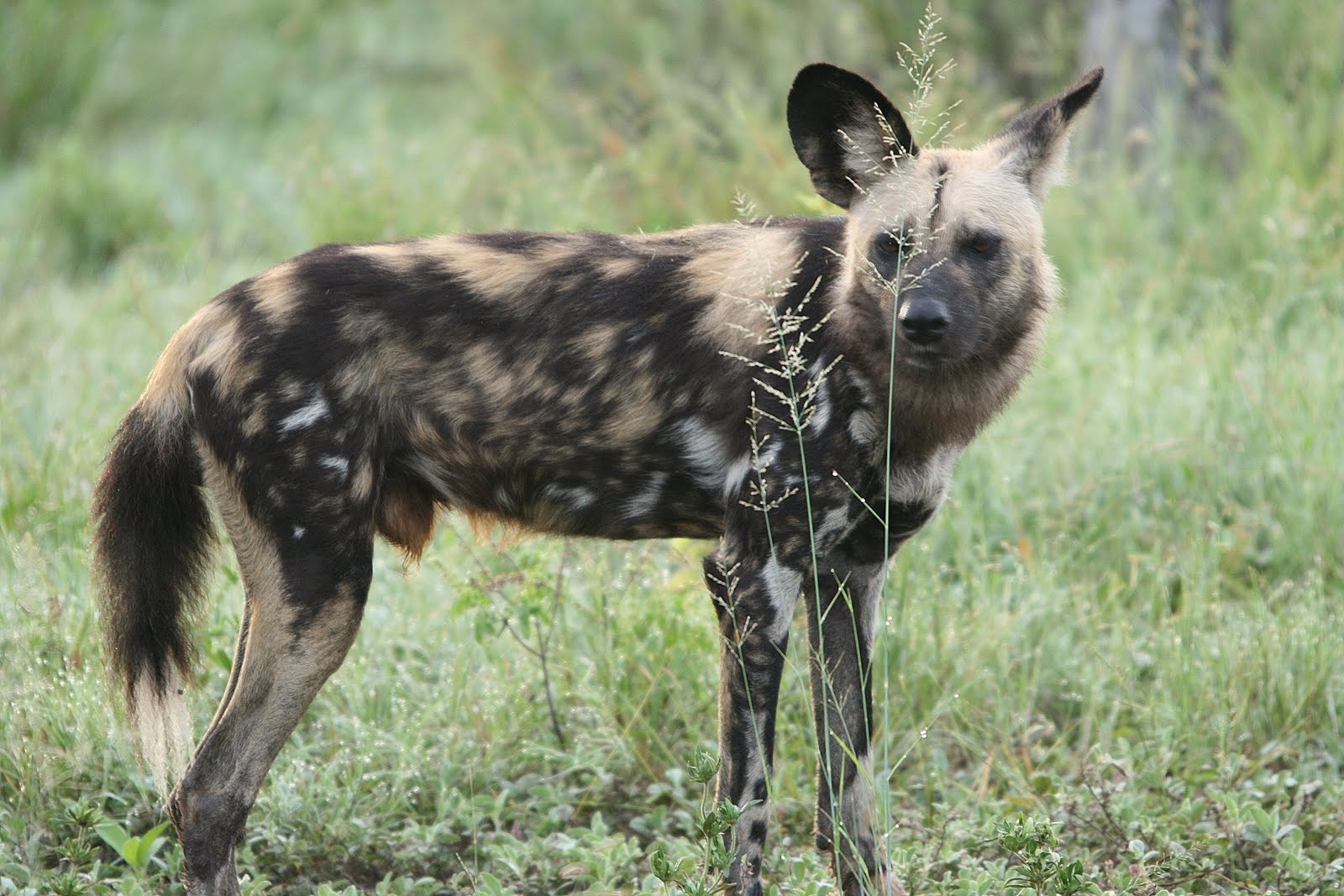
The African Wild Dog has large rounded ears a "Hyena-like" head and beautiful
mottled black, white with shades of light yellow brown patches of short hair giving it a
very distinctive appearance.
This beautiful dog-like animal is only a distant relative to our domestic canids.
A small pack of four adults were found napping under a tree in the late afternoon.
We waited patiently until they arose to begin their evening sojourn and watched them eagerly as they trotted slowly away.

They are exclusively carnivorous and like the North American Wolf, hunt for their prey cooperatively. They can run up to 35 mph and as long as 3 miles making it difficult for their prey to escape.
We were thrilled to experience the sight of these rare animals since they are considered endangered with only 5,000 of them remaining.

The Blackbacked Jackal reminded us of the North American Coyote by the way it moves.
It has a distinctive black and silver "saddle."
An interesting habit of laying on Elephant dung to mask its odor also hides it from predators.

Our guide was a big African gentleman named Ngande with a deep voice and keen sense of humor. I found out early that he was not into birds as much as we were but he quickly caught on when I was stopping him frequently to take photos.

A common resident throughout Botswana is the beautiful Lilac Breasted Roller.

The Kori Bustard (Ardeotis kori) is the largest bustard in Botswana and have become extinct in some areas due to habitat destruction from agriculture, development, hunting and a slow reproductive rate.
They are mostly terrestrial and one of the heaviest birds capable of flying.

The Southern Ground-Hornbill (Bucorvus leadbeateri) is also threatened in many parts of its range and confined to reserves and national parks.


The Plains Zebra (Equus burchellii) was present in great numbers grazing in the Savute marsh where the grass was lush and not far from water. To see them in such high density in this vast savanna, each with their slightly varied markings was truely one of the heights of our experience.

Hundreds of Cattle Egrets(Bubulcus ibis) followed the herd


Our guide was constantly in touch by radio with other guides and learned of a pride of lions found a few miles away. We arrived within minutes to see two male lions loafing in the shade in the late afternoon while other members of the pride were a few yards away near the water hole.
It was like watching a National Geographic episode on TV in HD but this time we were actually seeing the drama before us as it took place.

There less than 20 yards away were three 5 month old cubs drinking and playing near a water hole.

The cubs attacked their parents playfully and generally ignored us and the
sound of our cameras clicking away.

The cubs went to their mothers side periodically for comfort and affection which they received with licking and rubbing.

We were immersed in the action before us for nearly 45 minutes but these precious moments would remain in our memories the rest of our lives.
On the way back to our lodge we saw dozens birds unfamiliar to us.


The African Sacrid Ibis (Threskiornis aethiopicus) are common here but all of the wildlife in this wonderland were new for us.While passing through a grove of trees the stricking African Hoopoe (Upupa africana) posed briefly for a photo but didn't flair it's crest for us. Back in the open grassland a Northern Black Korhan (Eupodotis afraoides) appeared walking cautiously away from our approach.


Another amazing sunset on our last evening at Chobe as we headed back to our lodge with thoughts of the next adventure on the Zambesi River.


Friday, June 4, 2010

A NEW "LEASH" ON LIFE

It was the first day of June and for a change it wasn't raining. My wife was on state mandated furlough due to the budget crisis in California.

We decided to take a walk along the Mad River near it's mouth which is a short drive from our home.

The mouth of the Mad River in Mckinleyville California is a great place to enjoy the spectacular views of the river where it meets the sea.

While sitting in the warm sun on large log eating our lunch we realized that we were the only people in the area.

We scanned the area with our binoculars and observed over 90 Harbor Seals hauled out on the west shore of the Mad River where it makes a 90 degree turn from North to West before it reaches the Ocean.


Then we noticed in the distance that we were not alone anymore as a couple with two dogs were approaching along the rivers edge.

The dogs were running exuberantly, unleashed and one of them stopped and defecated near the waters edge.

I didn't observe their owners pick up the poop even though there are plastic bag dispensers at the trail head for that purpose.

On most beaches with a few exceptions dogs are required to be on a leash, but most people ignore the law. After all dogs need to run, play and get their exercise, don't they?

As we sat in the warm sun munching away, one of the dogs (Siberian Husky) came running up and nearly swiped the granola bar from my hand while shaking his wet body on us.

Although slightly irritated, we dismissed the incident as just an overly friendly and excited dog greeting strangers.

The dogs owners ignored its hyperactive behavior and the fact that it had just accosted two people minding their own business.

I personally don't mind if people allow their dogs to run, play and get their necessary exercise.
However, I don't appreciate dogs that are out of the control of their owners command either by voice or whistle.

On another occasion I witnessed a bloody dog fight in the same vicinity when two dog owners allowed their dogs to roam freely. It was a good reminder why dogs should be leashed in public areas.

We finished our lunch and walked past the couple and their dogs, which ran at us brushing against our legs while their owners yelled in vain for them to stop and come back.
The woman had a whistle which she blew as if there where a fire.

A few minutes later my wife and I were both checking out birds and the Harbor Seals when we were blindsided by both dogs as they jumped up and slammed against our backsides nearly knocking my wife off her feet.

This time I hollered to the owners asking them to "get their dogs under control". They whistled and called for their "puppies" but didn't say anything to us and avoided eye contact.

A few minutes passed while we were looking for a way to cross Widow White Creek when we heard the incessant loud screaming by the woman and her whistle blowing.

One of the dogs was swimming across the river and heading directly toward the beached Harbor Seals.


Now the drama had begun as I quickly took my camera from its backpack and headed toward the scene.
The dog owners were frantic, and the dog was ignoring their pleas to come back.
Here the current is deceptive, it looks calm, but is very strong and cold.
However, the Husky was on a "mission" and refused to be deterred.
I later found out that this Husky was a year old "puppy", and it was merely responding to its strong genetic impulses.

Apparently the owners either didn't realize or ignored the fact that their Husky breed tends to be hyperactive, impulsive, stubborn, and have an overactive prey drive.

On this day they discovered their Puppy's "inner dog" and perhaps will never forget.
As the Blue-eyed Husky neared the shore where the Harbor Seals were resting, they rapidly plunged into the water like dozens of Depth charges.

The obviously distressed woman, with her other dog now leashed, loudly pleaded, screaming and whistling for her dog to come back, while the man paced back and forth along the shore, helplessly calling "come here puppy."

Harbor Seal heads bobbed up several feet from the dog surrounding it. The Husky, I later learned, was swimming for the first time and seemed to intent on pursuing its intended target.

The dog showed no signs of letting up as it changed directions each time a different seal's head bobbed to the surface.

I asked the fellow if he wanted me to call for help but his attention was on his dog and he ignored me. I was concerned that the dog was in danger of drowning and also the stress on the Harbor Seals which are protected by law.
The Siberian Husky turned toward us several times but was quickly diverted by Harbor seals popping up from another direction.
A half hour had passed, and the dog was relentless in its pursuit though now beginning to show signs of tiring. He was working his way against the current, moving upstream nearly a half mile from its entry into the cold waters of the Mad River.
At this point , I could no longer watch this without taking some action, so I told the man that I was calling for help. He asked who I was calling, and I responded "911"!

I'm uncertain whether my action prompted him to remove his outer clothing with the intent to rescue his dog.

This, I thought to myself, could end up in tragedy, so the call was made.
I was concerned that he would swim out, not realizing how strong the current and how cold the water. I told his companion that I'd made the call, and she responded abruptly, "I wish you hadn't!"

In the meantime the now desperate owner stripped to his underwear, got as far as his waist and stopped in his tracks, realizing that the water was too frigid for a rescue.

I had been throwing sticks at water's edge trying to divert the dog's attention, without results.

Then finally, after nearly 40 minutes, the Husky, beginning to struggle, seemed to respond to the flapping of my hat as I knelled down at eye level to the dog.


Two officers from the McKinleyville Sheriff's office appeared on the trail overlooking the river at the same time the dog was nearing its relieved owner, who had dressed and was wading toward the bedraggled pup. As the man grasped his dog , I heard him say, "no more beach for you puppy."

The dogs now leashed, their owners took off in the opposite direction of the officers, while my wife and I ascended the trail toward the 911 respondents.

I answered their questions concerning what had happened and they seemed content that the situation no longer required their presence.

I wondered to myself why they didn't at least ask the dog owners to use a leash in the future.

Perhaps they decided that the near loss of the beloved puppy was better than any lecture they could give?

"Leash laws" generally require dogs to be on leash and under control whenever they are in public property. In some citys leash laws are strictly enforced. Apparently they are not enforced in Humboldt County.
Leash laws are made for good reasons including: Protection of humans, wildlife and other pets, prevention of predation or disturbance of wildlife, prevent transmission of diseases from dogs to wildlife especially fox, coyotes and deer, and prevent contamination of local water supply.

We were relieved that this story had a happy ending and hope that the dog owner's learned a very important lesson.


Tuesday, April 27, 2010

Okavango Delta 2 Xugana Island Lodge Botswana


Our guide Frank Mochaba(photo above)at Camp Moremi was assigned to take us halfway by boat to Xugana lodge which is a 3 hour trip. We traveled through sometimes narrow channels of permanent swamp and open waters surrounded by dense stands of Bulrush,Common reed,papyrus, and dotted with blankets of Day waterlilys and Water Chesnut along the channel fringes.


It is believed by geologists that the Okavango River once reached the sea. Tectonic movement created a series of parallel faults (Graben faults)collapsing the earth which led to the formation of the inland delta or alluvial fan.(1) The Okavango delta is one of the world's largest inland water sytems at 16,000 sq. km.

Along the way we observed many new birds and insects as the channels narrowed bringing us within close view.


The African Darter(Anhinga rufa)or locally called "Snake bird" because of its habit of swimming with only the neck and head above the water.


The Little Bee-eater fly's off its low perch on Papyrus to snatch butterfly's and other flying insects and is one of the many striking and beautiful birds seen in Africa.


The Woodland Kingfisher is a summer migrant from central Africa that doesn't fish as the name implies but rather preys on large insects and small reptiles.

At midway we were met by our next guide named "Losty". While saying farewell to Frank I caught my only glimpse of the unmistakeable Pel's Fishing Owl as it glided out of and quickly into dense canopy across the channel.


Losty slowed down when his sharp eyes caught a glimpse of something that blends in well with its background. An example is this large Crocodile floating on the waters surface.


Water Monitor is a large aquatic lizard that feeds on just about anything it can handle including crocodile eggs,frogs,crabs,etc.


The African Jacana has extremely long toes which enables it to walk on aquatic vegetation such as water lily leaves giving it the name "Jesus" bird.

We arrived at our destination on a small island greeted by the the staff of the Xugana lodge with warm smiles, moistened towels and a cool drink.

After a brief orientation we were led to our room overlooking the water where we had time to relax,write notes and take in the many sights and sounds.
That afternoon we went out on another boating excursion to look for more wildlife.
We passed through very narrow channels that are maintained by Hippos and some by the staff at the lodge.

It was a beautiful sunset on this evening and we were surprised by a special dinner setting that the host's prepared for both Kimberley and I celebrating our year of "Big" birthdays.

Our trusted guide "Losty" proved that he could dance with the best of them and ignite the urge in all of us with the help of the wonderful beat of African music.

The next day we explored the delta in the rain and visited a small island and saw the large African(Cape)Buffalo,Elephants and Vervet Monkeys.

Later in the afternoon the sun came out and we saw many more beautiful birds including this splendid Great White Egret perched in a tree along the water.

In the evening we were enthralled at the sight of several Hippopotamus keeping a close eye on us.

This Bat was determined to be a Tomb Bat (Taphonzous mauritianus) and was photographed roosting near the dining area. Other bats were observed flying out from under the eves of our room at dusk.

We walked around the lodge area before departing observing many birds and a Marsh Mongoose. This Greater Blue-eared Starling was dazziling to look at and posed briefly for this photo.

It was a brief two days at this unique setting on the waters edge of the incredible Okavango delta. We barely scratched the surface of its many wonders but
the memories will linger as long as we live.
Thanks to the dedication of all the warm and friendly staff we had a great adventure and enjoyed excellent food and accomodations.

Some of the Staff at the Xugana Lodge.(Arnold,MPHO,Obie and Candy).

References: Butchart, Duncan. 2000. Wildlife of the Okavango,
126 pgs. Struick Nature.
Sinclair,I. et.al. 2002. Birds of Southern Africa.
Struick publishers.

Wednesday, April 21, 2010

Okavango Delta at Camp Moremi

On the 21st of March we left Deception Valley Lodge on a Bush plane for a 45 minute flight to our next lodge. Within minutes we could see large areas of water and marsh below. We landed at Camp Moremi which is situated in the Xakanaxa lagoon in the heart of the Okavango delta at Moremi Wildlife Reserve. This area was the first to be set aside by tribal people rather than colonial pioneers. We rode in a Toyota Land Rover for 15 minutes, sometimes through flooded roads to Camp Moremi where we stayed in fancy tents on wood foundations overlooking the riparian woodland. On our first game drive we felt that we had come to the land of Oz with animals we both had only seen on TV or at Zoos previously. Here they were wild and free in their natural habitat.

The Hippopotamus with eyes, nose and ears protruding above the waters surface watched us closely as our vehicle drove slowly by and paused for a photo.


These huge aquatic mammals play a significant role in maintaining the many channels in the Okavango delta. The Okavango was teeming with wildlife and our knowledgeable guide (in photo) Frank Mochaba gave us our “money’s worth” which added greatly to the experience that was beyond our greatest expectations. Red-Billed Hornbill was one of the many birds that got our attention. Exotic birds everywhere, unfamiliar sounds reminiscent of Jurassic Park and the Elephants that we have become so familiar with from our early childhood days appear as never before like some giant prehistoric creature out of the past. African Fish Eagles with their snow white head and chest and rust brown body are conspicuous as they perch on large branches in trees overlooking the water. The Waterbuck (Kobus ellipsiprymnus) is a large "shaggy" antelope with short legs and a white rump ring and long heavily ridged horns with points that curve forward. The African Sacred Ibis (Threskiornis aethiopicus) is a common resident of northern and eastern Botswana in islands and estuaries and grasslands. Savanna Baboons in small troops appear in the open wooded Savannah. The female in estrus shown here was pursued by the dominant male below.

A female Greater Kudu above. The Lodges that we stayed at served the meat of Kudu and Impala but the Kudu is not as common due to habitat loss and hunting. The Impala were the most numerous antelope we saw and the rutting season had begun. During the rutting season the male establishes territories and spends much energy chasing off rivals who vie for females in the herd. We were thrilled to get close to a pride of lions in the late afternoon and watched them lying lazily in lush grass licking their fur and paws fastidiously. At night the loud "contact" calls of the Spotted Hyaenas woke us. While awake we were entertained by the deep grunting sounds of the Hippopotamus that come out of the water to feed after dark. It was a symphony of African sounds and we lay in the dark enjoying the music. The Nile Crocodile lay resting in the evening light not far from the waters edge. A family of Banded Mongoose appeared near their den in a large termite nest. Banded Mongoose(Mungos mungo) are highly sociable living in packs of up to 40 and are active durning the day when they forage for insects,mice,reptiles, amphibians, ground nesting birds and their eggs. It was time for our "Sundowners" and what a perfect place we thought to sip a glass of wine, relax and realize that we were actually in this wonderful land of Africa so far away from the redwoods and our cats. Next blog: Xugana Island Lodge.